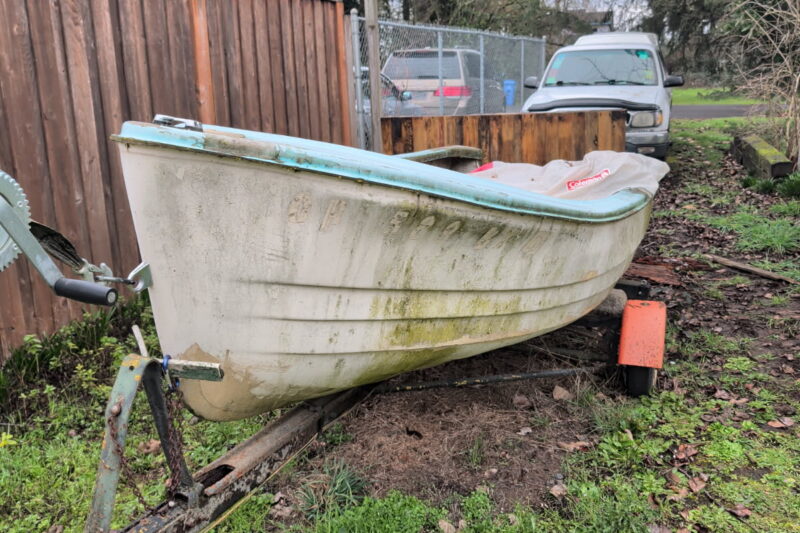
An old boat can sit unnoticed for a surprisingly long time. It may spend years underneath a tarp, parked beside a garage, sitting on a deteriorating trailer, or tucked away on a rural property outside Eugene. The owner may have every intention of repairing it someday, but eventually the project gets pushed further and further into the future.
Then the boat becomes less of a project and more of a problem.
For boat owners around Eugene, Oregon, professional boat removal and marine scrapping can provide a practical solution when an unwanted vessel has reached the end of its useful life.
Eugene and the surrounding Willamette Valley have plenty of opportunities for fishing, recreation, boating, and outdoor activities. Nearby waterways and destinations such as Fern Ridge Reservoir contribute to the region’s boating culture, while the larger Willamette River system provides additional access for recreational users.
But boats do not last forever.
Fiberglass eventually deteriorates. Aluminum corrodes. Engines fail. Trailers become unusable. Upholstery falls apart. Years of exposure can turn a once-enjoyable vessel into an expensive restoration project.
When the cost of fixing the boat no longer makes sense, scrapping it can be the better option.
Boat Scrapyards helps owners deal with those unwanted vessels by providing a straightforward starting point for boat removal, disposal, and marine scrapping.
Eugene Boat Removal FAQs
Can you remove a boat that does not run?
Yes. Non-running boats are common candidates for removal. A boat does not need to be operational to be considered, although the vessel’s condition, size, location, and accessibility all affect the removal process.
Do you remove boats from residential properties?
Boat removal may be possible from driveways, side yards, storage areas, rural properties, and other locations when the owner or authorized party has permission to have the vessel removed.
Can an old boat trailer be removed with the boat?
In many cases, the trailer is part of the overall removal project. A damaged or unusable trailer may require additional planning, especially if the wheels, tires, axles, or frame are severely deteriorated.
What types of boats do you scrap?
Boat Scrapyards can receive inquiries involving fishing boats, aluminum boats, fiberglass boats, sailboats, runabouts, cruisers, pontoon boats, work boats, damaged vessels, and other unwanted watercraft.
What if my boat has been sitting outside for years?
Long-term outdoor storage can cause substantial deterioration, but an old boat may still be removable. Providing accurate information about its condition and location helps determine the appropriate approach.
Should I repair the boat before having it removed?
If you have already decided the vessel is not worth keeping, expensive repairs may not be worthwhile. The boat can be evaluated in its existing condition so that removal requirements can be determined.
The Boat You Keep Meaning to Fix
Almost every old boat has a story.
Maybe it was purchased for weekend fishing trips.
Maybe it belonged to a parent or grandparent.
Maybe it was the project boat that was supposed to be restored over the winter.
Maybe the owner simply stopped having enough time to use it.
Whatever happened, the vessel eventually stopped moving.
At first, that might not seem like a big deal.
A boat sitting on a trailer does not necessarily create an immediate problem. But after several seasons of sitting unused, deterioration starts to accumulate.
The cover breaks down.
Water gets inside.
The trailer develops problems.
The engine becomes harder to start.
The interior deteriorates.
Vegetation begins growing around the boat.
Eventually, the owner is left with a large vessel that cannot realistically be sold, used, or moved without considerable effort.
That is where professional boat removal becomes useful.
Eugene’s Inland Boating Connection
Eugene is not a coastal city, but that does not mean boats are uncommon in the area.
The Willamette Valley provides access to rivers, lakes, reservoirs, and recreational destinations used by anglers, boaters, paddlers, and outdoor enthusiasts.
Fern Ridge Reservoir, west of Eugene, is particularly relevant to local recreational boating and fishing.
That inland environment also means many boats are stored on trailers rather than kept permanently in the water.
And that creates a very specific type of disposal problem.
An owner may be able to launch a boat when it is functioning properly, but an abandoned or severely deteriorated boat on a trailer can become extremely difficult to move.
A trailer with flat tires, seized wheels, rusted components, or structural deterioration cannot necessarily be towed normally.
The boat may need to be removed from the property without relying on the trailer’s ability to function.
Why Boats Around Eugene Become Scrap
Boat owners reach the decision to scrap their vessels for many different reasons.
Some are financial.
Others are logistical.
Sometimes the boat is simply too old.
Common reasons include:
- Failed engines
- Expensive mechanical repairs
- Damaged hulls
- Water intrusion
- Deteriorated interiors
- Trailer failure
- Severe weather exposure
- Long-term neglect
- Accident damage
- Outdated electrical systems
- Inability to find a buyer
- Lack of storage space
- Inherited boats
- Owners who no longer use the vessel
- Restoration costs that exceed the boat’s value
The economics can be especially important with older recreational boats.
A boat might look like a bargain because it is inexpensive to purchase, but bringing it back to usable condition can require substantially more money.
By the time the engine, trailer, electrical system, hull, seats, and other components are repaired, the owner may have invested far more than the vessel is realistically worth.
At that point, scrapping becomes a reasonable alternative.
The Types of Boats We Scrap, Salvage & Dispose Of
Boat Scrapyards works with inquiries involving many different types of unwanted boats.
In and around Eugene, those projects can include smaller recreational vessels, fishing boats, boats stored on trailers, and larger vessels that have been sitting unused for extended periods.
Potential boat removal projects include:
- Aluminum fishing boats
- Fiberglass fishing boats
- Bass boats
- Runabouts
- Bowriders
- Pontoon boats
- Sailboats
- Cabin cruisers
- Center-console boats
- Utility boats
- Older recreational vessels
- Damaged boats
- Non-running boats
- Boats with deteriorated trailers
The size of the vessel is only one consideration.
A small fishing boat can be surprisingly difficult to remove when it is surrounded by landscaping or stored behind a house.
A much larger boat may actually be easier to access if it is sitting in an open storage yard.
That is why every removal needs to be considered according to its individual circumstances.
Fiberglass Boat Disposal in Eugene
Fiberglass boats can remain structurally useful for many years, but neglected vessels eventually develop significant problems.
Water can enter damaged areas.
Wood components can deteriorate.
Hardware can corrode.
Engines can fail.
Interior materials can break down.
When enough of these problems accumulate, restoration can become impractical.
Fiberglass also creates a different disposal challenge from metal.
The hull itself is not simply a large piece of scrap aluminum or steel. A fiberglass boat may contain several different materials that need to be considered separately.
An owner attempting to dismantle one personally can quickly discover how much labor is involved.
Removing seats, hardware, wiring, mechanical components, tanks, and other equipment is only the beginning. The hull itself remains large, heavy, and difficult to transport.
Professional boat removal allows the owner to avoid turning the project into a months-long demolition job.
Aluminum Boats & Marine Scrapping
Aluminum boats are common among anglers and recreational boaters because they are durable and relatively lightweight.
They are also particularly relevant to marine scrapping because aluminum has a recognizable scrap value.
An old aluminum fishing boat may contain additional valuable metal components, including stainless steel hardware, wiring, brackets, railings, and other equipment.
However, the presence of aluminum does not automatically mean a boat has a particular dollar value.
The amount of metal, vessel size, condition, equipment, transportation requirements, and current scrap-market conditions all matter.
The important point is that an aluminum boat should be evaluated as an entire removal project rather than simply estimating its value based on the hull.
What Makes Old Boat Trailers Such a Problem?
The boat may be in acceptable condition.
The trailer may be the real issue.
Trailers spend much of their lives exposed to rain, road moisture, mud, and changing temperatures. When a boat has been neglected for years, the trailer may have flat tires, seized bearings, rusted components, damaged lights, or structural problems.
If the trailer is no longer safe to tow, simply attaching it to a truck is not an appropriate solution.
This is particularly important when an owner is preparing to sell or dispose of an old boat.
A buyer may not want the vessel because they cannot transport it.
A conventional towing company may not want to move it because the trailer is not roadworthy.
The owner is then left with a boat that has become increasingly difficult to relocate.
Professional removal can provide another option.
Boats Sitting on Rural Properties
The Eugene area extends into a large network of rural and semi-rural communities.
That means unwanted boats are not always sitting in obvious commercial storage locations.
A vessel may be parked on acreage, beside a barn, behind a workshop, or along a residential property where it has been forgotten.
Rural storage can make an old boat even easier to overlook.
There may be plenty of space, so nobody feels pressure to deal with it immediately.
But eventually the property changes hands, the land needs to be cleaned up, or the owner simply decides that the boat has to go.
At that point, access becomes an important part of the removal process.
Large trees, fences, gates, outbuildings, uneven ground, and narrow access routes can all affect how equipment reaches the vessel.
Boat Removal From Storage Facilities
Not every boat belongs to a homeowner.
Storage facilities, marinas, private yards, and boat storage areas can accumulate unwanted vessels as well.
An owner may stop paying storage fees.
A project boat may remain unfinished.
A damaged vessel may sit for years while the owner decides what to do.
For the storage operator, an unwanted boat is more than an eyesore.
It is occupied space.
Clearing old vessels can help make room for customers who actually need storage.
However, ownership and authorization should always be addressed before a boat is removed. Once the responsible party has the necessary authority, arranging professional hauling can make the physical cleanup much easier.
When Boat Restoration Becomes a Bad Investment
There is nothing wrong with restoring an old boat when the numbers make sense.
The problem is assuming that every boat deserves restoration regardless of cost.
An older vessel with an engine that needs replacement, a deteriorated trailer, damaged wiring, worn interior, and structural problems can quickly become a very expensive project.
Then there is the owner’s time.
Boat restoration requires research, parts, tools, labor, storage, and patience.
If the boat has already spent years sitting untouched, there is a good chance the project will require even more work than initially expected.
Sometimes the smartest decision is not to restore the boat.
Sometimes the smartest decision is to remove it.
Marine Scrapping Is More Than Breaking Down a Hull
A boat contains a collection of materials and systems.
Depending on the vessel, the scrapping process may involve:
- Aluminum
- Steel
- Stainless steel
- Copper wiring
- Bronze hardware
- Engines
- Outboard motors
- Propellers
- Fuel-system components
- Batteries
- Electrical equipment
- Trailer parts
- Marine electronics
- Pumps
- Hardware
These components can have different handling requirements.
The goal is not simply to drag an entire boat somewhere and call the job finished.
Marine scrapping involves considering the materials and components that make up the vessel.
That is one reason professional boat disposal is preferable to leaving an old boat beside a property and hoping someone eventually takes it.
What Happens After Your Boat Is Picked Up & Hauled Away?
Once the boat has been removed, the vessel can be evaluated according to its construction and condition.
Metal components can be separated for scrapping. Mechanical equipment can be addressed separately. Trailer components can be handled independently from the hull.
Other materials may require different disposal methods.
The exact process depends on the boat.
For the property owner, however, the result is much simpler.
The boat is gone.
The driveway is open.
The backyard is usable again.
The storage space is available.
And the owner no longer has to look at an old vessel and wonder when they are finally going to deal with it.
Serving Eugene and the Surrounding Area
Boat Scrapyards provides a starting point for boat owners and property owners seeking removal and scrapping solutions around Eugene.
The need can extend into surrounding communities throughout the Willamette Valley and Lane County, depending on the vessel’s location and accessibility.
A boat does not have to be sitting directly beside a major waterway to become a disposal problem.
It can be sitting miles from the water.
It can be parked on a trailer behind a house.
It can be stored at a private property.
It can be occupying space in a yard or storage facility.
Wherever the boat is located, the first step is determining how it can be safely removed.
Ready to Get That Boat Out of the Yard?
If you have an old boat that has been sitting around Eugene for years, waiting for a repair project that never seems to happen, there is no reason to keep postponing the decision.
The boat is taking up space.
The trailer is deteriorating.
The weather continues to take its toll.
And the restoration bill is probably not getting smaller.
Boat Scrapyards can help you move toward a practical solution.
Whether you have an old aluminum fishing boat, deteriorating fiberglass vessel, damaged recreational boat, non-running cruiser, or unwanted boat sitting on a trailer, you can start by providing information about the vessel and where it is located.
There is no need to make the boat look presentable before asking about removal.
There is no need to spend thousands of dollars restoring something you do not want.
And there is no reason to keep a neglected boat taking up valuable property space year after year.
When the vessel has reached the end of its useful life, professional boat removal and marine scrapping can make the cleanup much easier.
For Eugene boat owners ready to stop storing yesterday’s project, Boat Scrapyards is ready to help get the unwanted vessel out of the way.